The narrowing of Uzbekistan as one heads east of Samarkand brings a very concentrated feel to the geography of this part of central Asia. After several days cycling across the vast expanse of the desert, during which huge distances separated pockets of civilisation, let alone countries, it’s been captivating to have wended a path that has now brought me so close to national boundaries. Uzbekistan occupies a strip of not much more than about 25 miles at its narrowest point, with Kazakhstan (to the north) and Tajikistan (to the south) providing the squeeze. At various points over my ride in recent days, I’ve been within touching distance of each of those countries.
The funnelling of the country has had the psychological effect of drawing Kyrgyzstan (the last of the six countries I’m visiting on this ride – after Turkey, Georgia, Azerbaijan, Kazakhstan and Uzbekistan) into view – perhaps sooner than was warranted by the substantial kilometreage left on the road to reach it! I’ve had six days on the bike since leaving Samarkand, and I’ll only reach Kyrgyzstan the day after tomorrow.
Those six days have been highly varied – in terms especially of topography. The rides to Jizzakh and Guliston were hot and largely flat, with the countryside changing only subtly, apart from the deviation I had to make off the main Tashkent (capital city) road to reach Jizzakh. There, rolling hills and rocky outcrops provided welcome definition to the closing stages of the day’s ride.
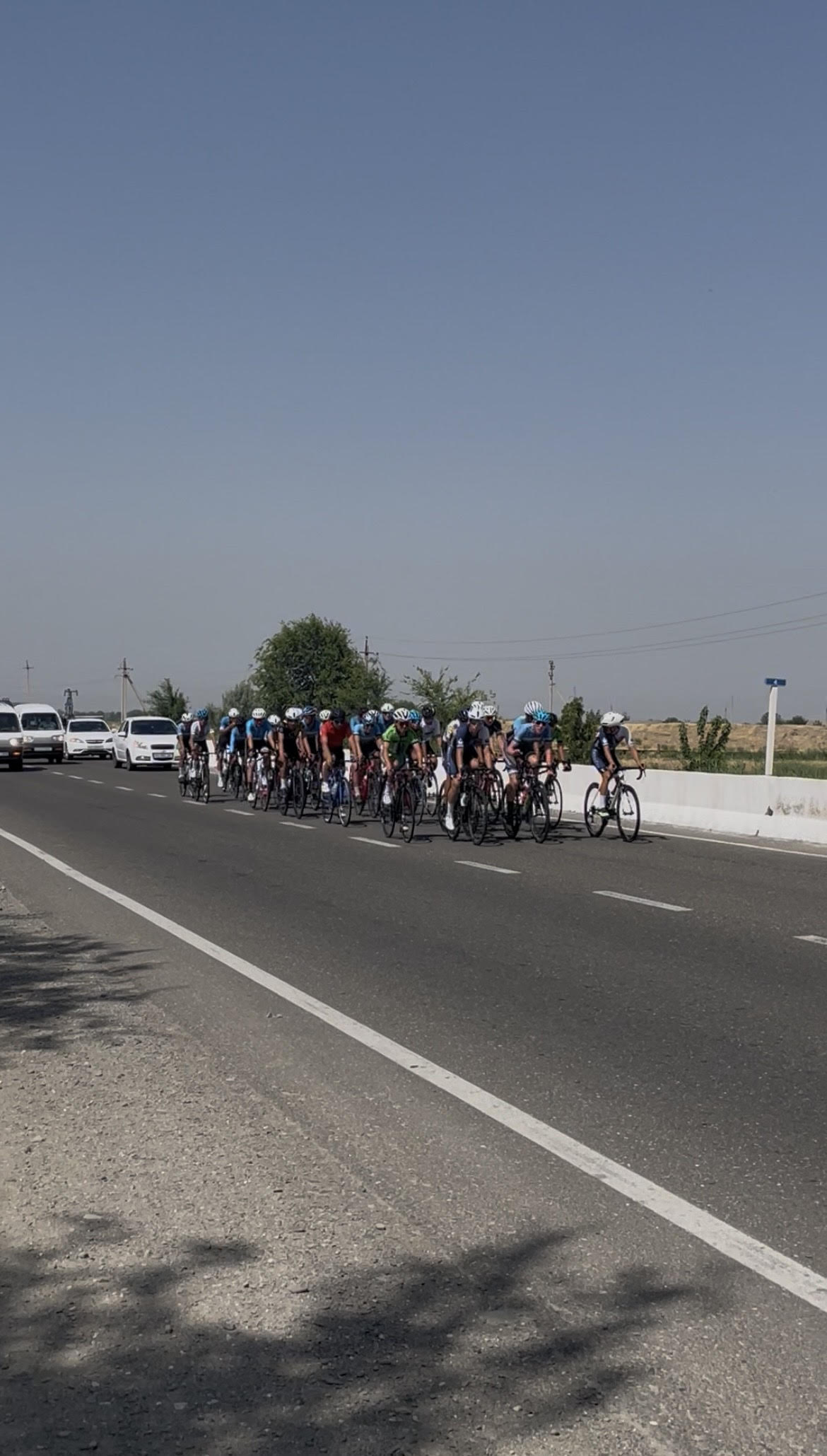
The next morning, not far out of Jizzakh, I encountered a road closure, followed by the happy reason for it: a bike race being overseen – judging by the flotilla of mini vans following the riders – by the Uzbekistan national cycling team. I was grateful for the warmth of the reaction of the riders and their entourage to me and my fully laden touring bike.
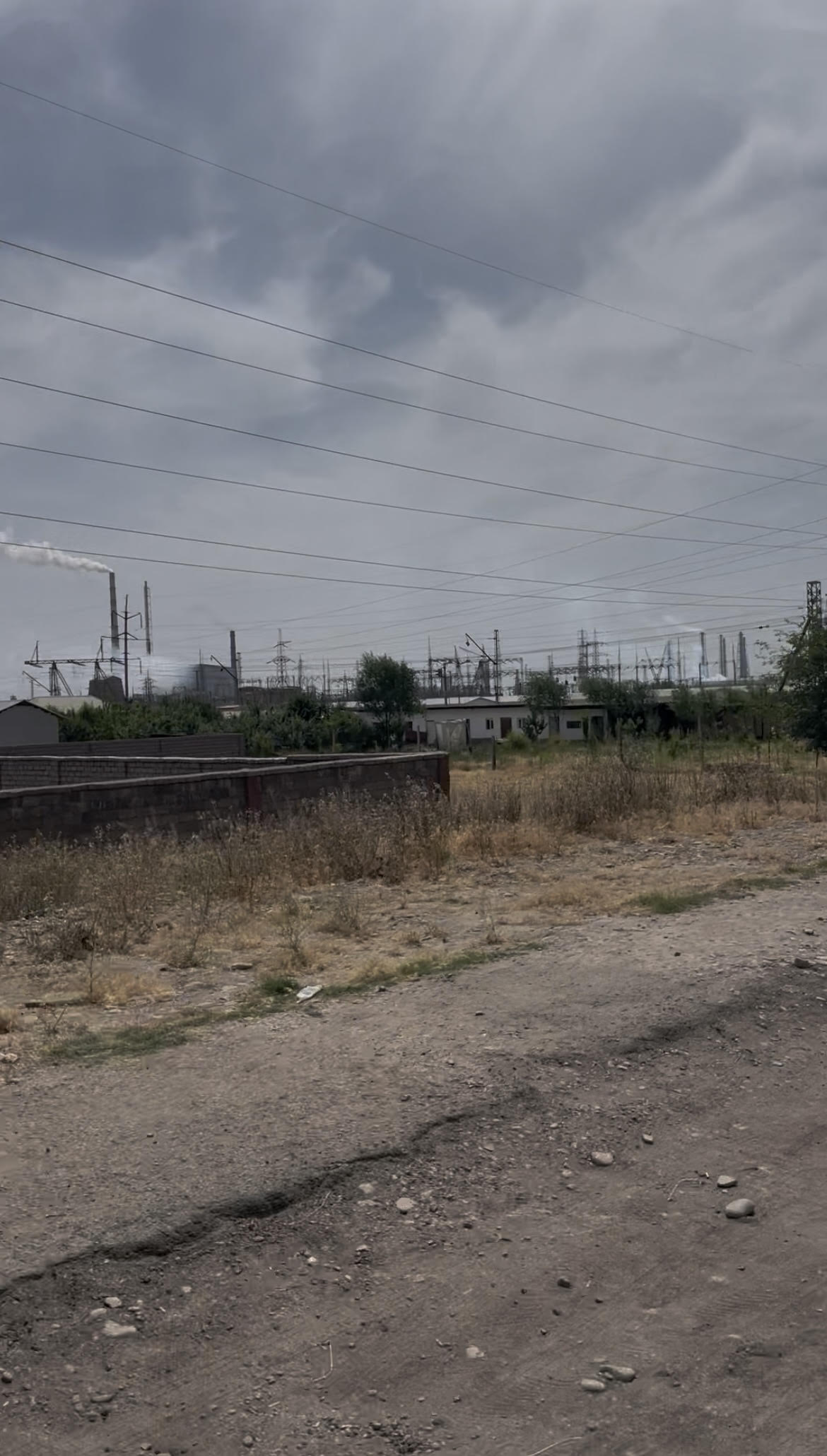
From Guliston, I rode on to Almalyk, a 1930s Soviet ‘company city’ built to exploit the local reserves of copper, lead, zinc, gold, silver and barite. As I cycled into the heart of the smelting operations on the western side of the city, it wasn’t hard to understand why Almalyk is considered one of the most polluted places on Earth. The air was thick with the byproducts of smelting – visually, but also in terms of the smell and taste of the air. It looked and felt like a highly toxic environment, and I felt very sad to see children growing up in the midst of it. The combination of such corrosive industrial activity and the trappings of childhood in the shape of playgrounds and mini football pitches felt utterly incongruous, and my heart ached for the children who know no differently about the world around them.
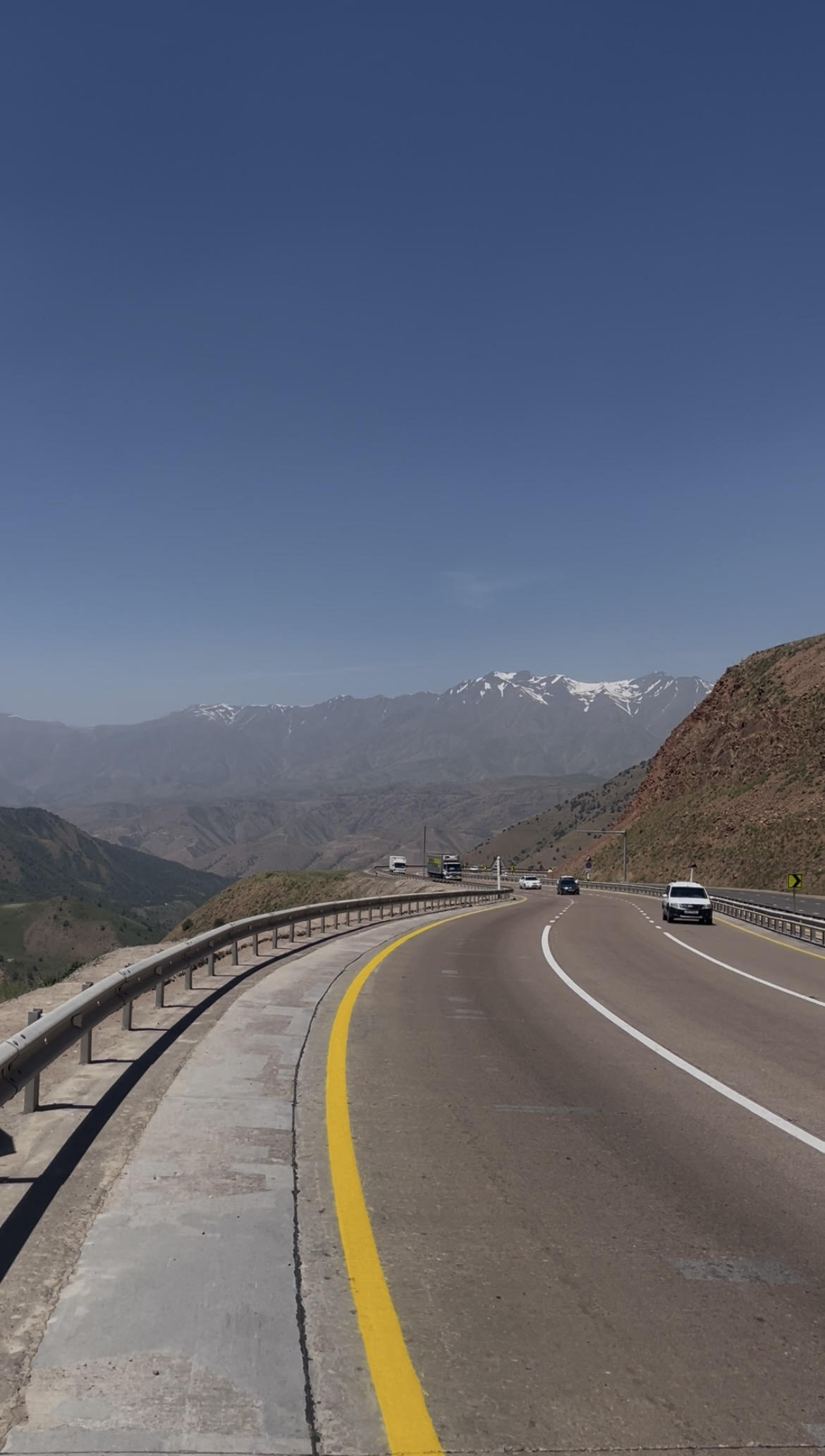
Following a short hop across to Angren – a city that kept the industrial theme alive with its still flourishing coal industry – I began the two-day ride through the mountains to Kokand. Yesterday was spent hauling myself and my bike up a formidable climb to an elevation of 2,150 metres above sea level, and today reaped the benefits, with a steep descent most of the way south to Kokand. It’s been a great pleasure to ride some of this part of the journey with Bijou, the British cyclist who I first met in Beyneu (Kazakhstan). We’ve been overlapping a bit as we’ve crossed Uzbekistan, but have only latterly had the chance to ride together.
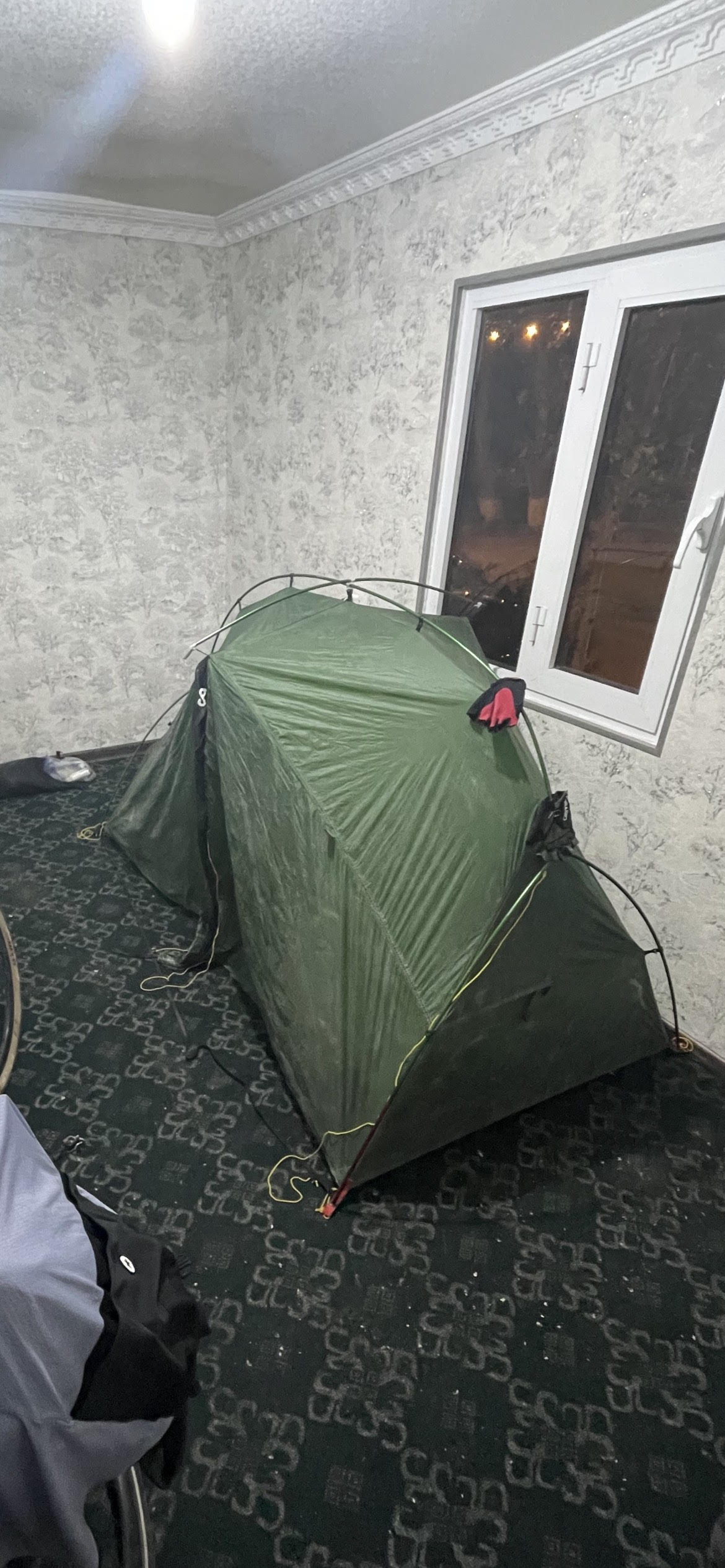
Last night, thanks to Bijou’s valuable research, we were able to stay the night in a couple of rooms in a ‘choyxona’ (tea house). Their sole furnishing was a shabby carpet, but they gave us adequate space in which to put our tents and attempt to get some sleep! Unfortunately, the rooms sat next to the tea house’s car park, which became frustratingly noisy with loud chatter from about four o’clock this morning.
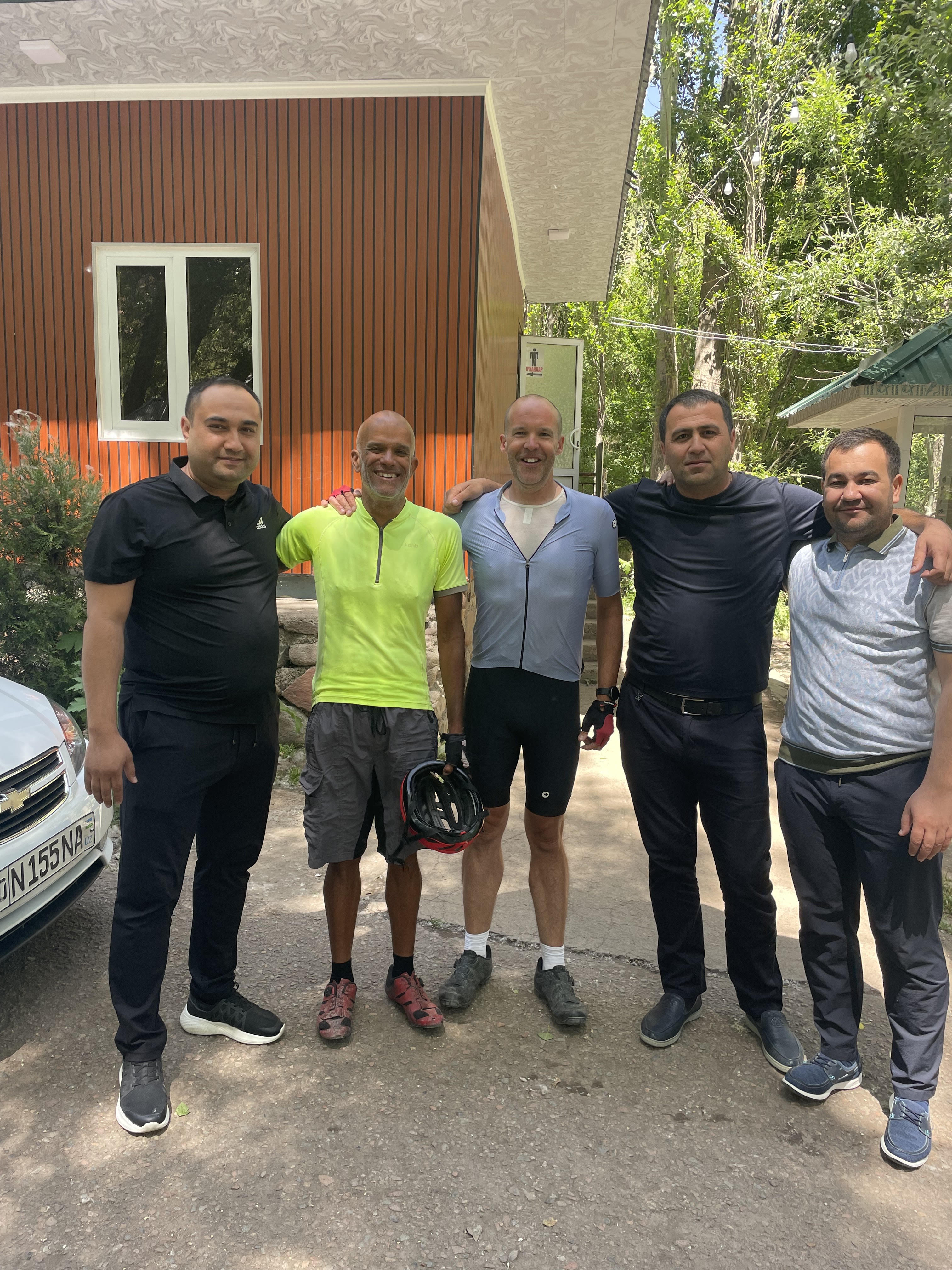
On arriving at the tea house, we’d had a very warm welcome from some friendly Uzbek men who were keen to get a group photo with Bijou and me, but there was slightly less warmth from the tea house staff in terms of what it would be possible for us to eat for a late lunch. The business was stangely rigid in its commitment to provide only very large platters of food for groups of passing travellers, but not plates small enough to feed just two (albeit quite hungry!) cyclists.
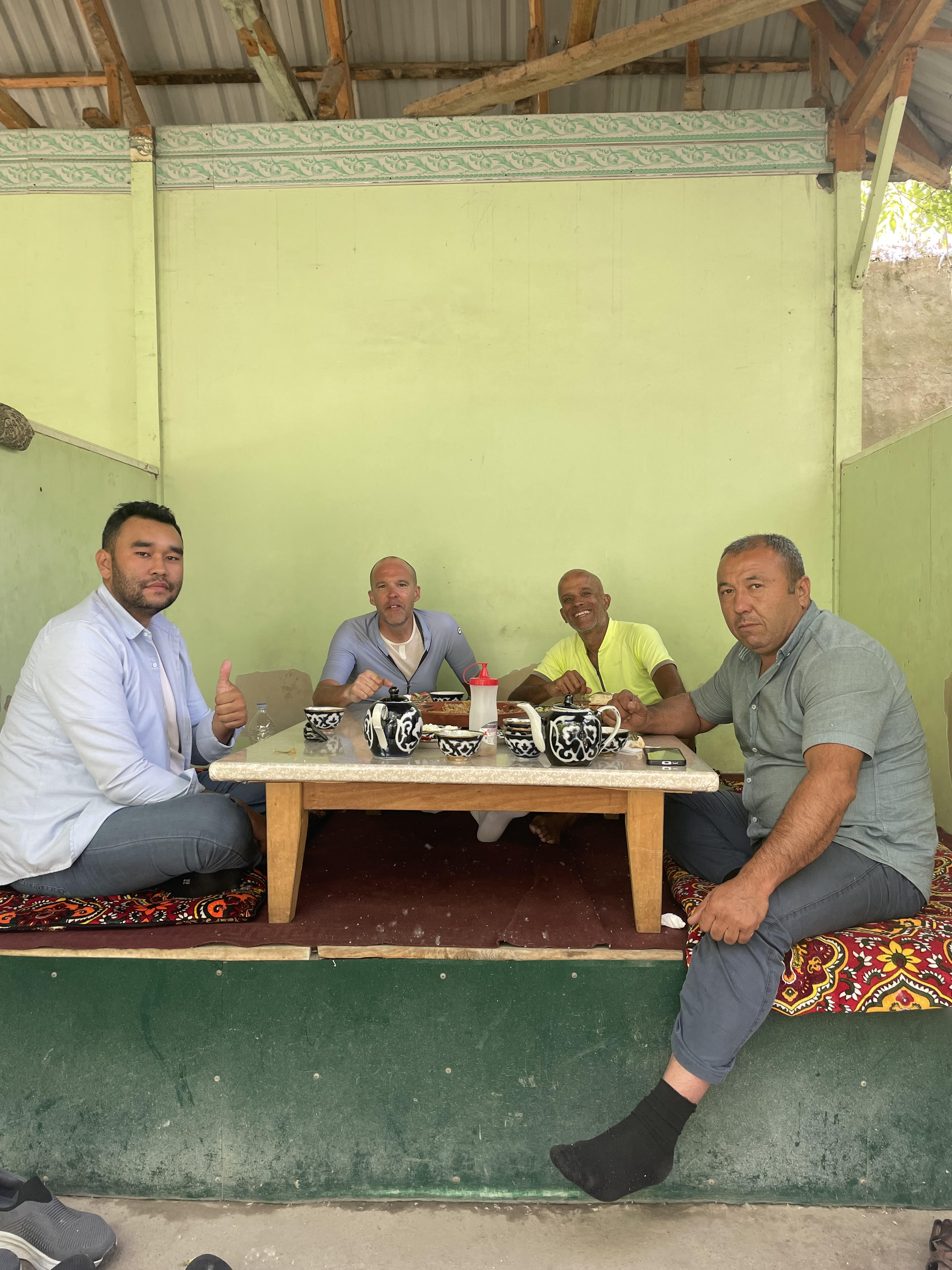
With frustration growing, a kind man (who later explained that he was a doctor in Tashkent) and his friend invited us to join them for a large plate of plov (rice and mutton), tomato salad and Uzbek non (bread) at a ‘tapchan’ in the garden of the tea house – a raised, wooden platform that combines a large bed-like area with a table at which everyone eats. They wouldn’t accept any contribution from us for the meal – yet another example of the ceaseless kindness of strangers that so typifies these cycling adventures.
From here in Kokand, it’s a two-day bike ride to Osh (the second largest city in Kyrgyzstan), and I’ve decided to end this adventure there. Obtaining reliable information about the feasibility of cycling into the Kyrgyz mountains, and in particular as to whether a key pass – at an altitude of 3,100 metres – will have reopened by then (it does so for only three months of the year) has proved very difficult. Such is Kyrgyzstan’s geography that my only alternatives to crossing the country actually involve passes at even higher altitudes!
Dealing with uncertainty is part and parcel of long-distance cycling ventures, but that uncertainty usually occupies a spectrum with plenty of nuance and scope to problem-solve. The uncertainty in seeking to navigate the heart of Kyrgyzstan is different, with no back-up plan available should I get stuck. It was no doubt optimistic to believe that my route would have opened up unambiguously by now (typically it does so by the beginning of June, but sometimes at that stage only to 4×4 vehicles). Faced with the ambiguity of the situation on the ground, making Osh my destination for this ride is the right decision. The corollary of that decision – that I can now be home in time for our youngest’s 13th birthday – brings me more joy than I could ever need to offset any disappointment on my bike.
 A bike ride around the world